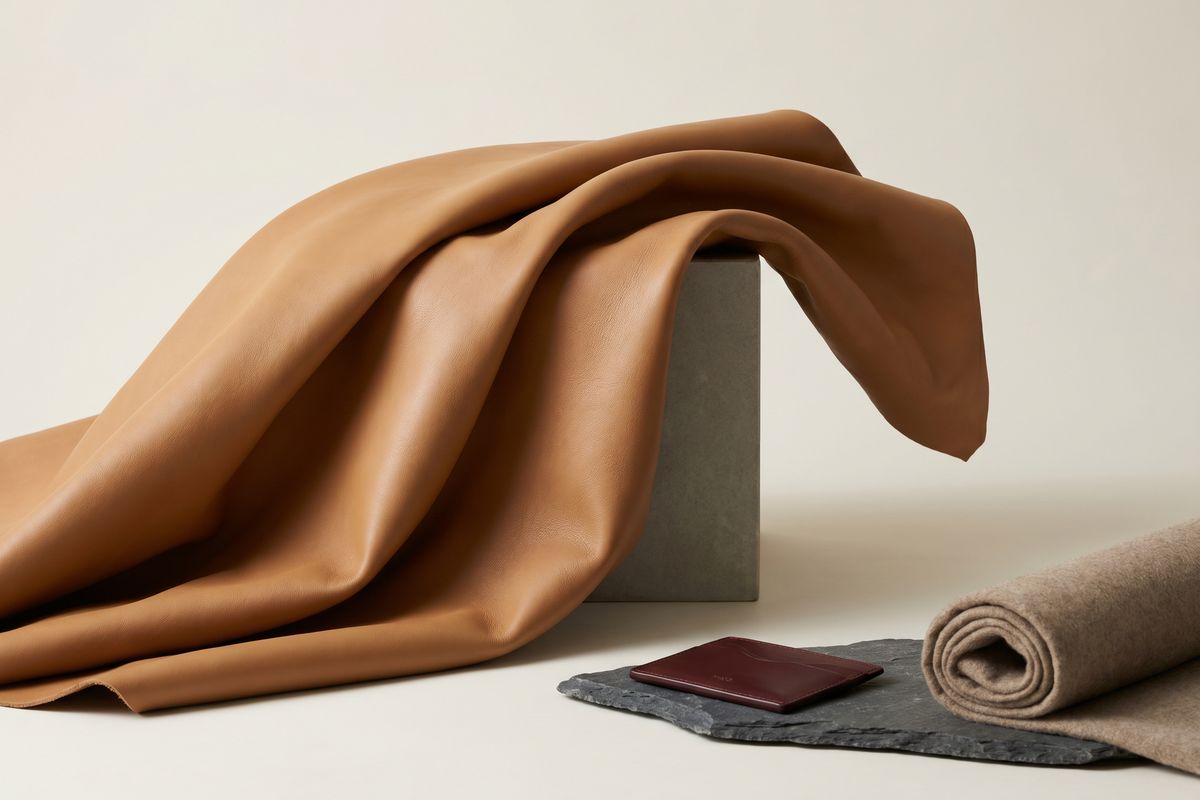
Plain answers to (almost) any question about leather.
Leather has its own language — half of it old craft, half of it laboratory. This is that language, written for everyone: designers, specifiers, buyers, and the simply curious. It follows a hide from the meat-industry by-product it starts as, through tanning, finishing, colour and the tests a material must pass to earn its place on a plane, in a car, or on a yacht. It's the industry, not just our house. And where a step carries a real sustainability story — a cleaner chemistry, a reused by-product — you'll find a short note alongside it.
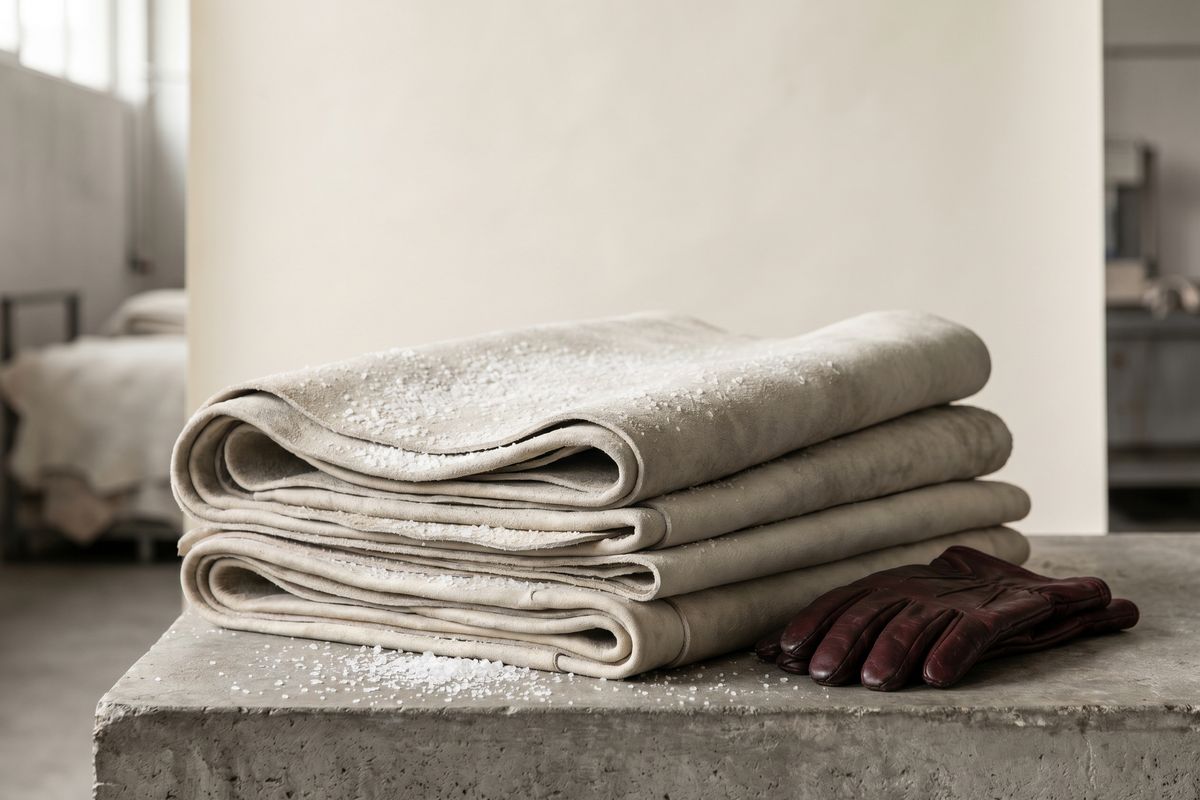
Leather begins as a raw animal hide — a by-product of the meat industry. Left alone, it would simply rot. Tanning is the chemistry that turns a perishable skin into a stable, lasting material. Here is how that happens, in order, and the words you'll hear along the way.
The starting point — a salted raw hide, chosen with care.
Every leather starts with a hide. The leathers here begin with South German bull hides, chosen for their size, even substance and tight, clean grain. A fresh "green" hide spoils within days, so it's cured — usually heavily salted — to pull out moisture and hold it stable on the way to the tannery, where it's soaked clean again before the real work begins.

The wet prep work — getting a bare, clean hide ready to tan.
Before any tanning, the hide moves through the "beamhouse": the wet preparation stages. It's soaked back to softness, treated with lime to loosen the hair, unhaired, and fleshed — the fatty underside scraped away. What's left is a clean, bare hide, evened out and ready for the tannage. None of it is glamorous; all of it is essential.
Setting the hide's acidity so the tannage can take hold.
A short bath of acid and salt brings the hide to just the right acidity for tanning. Think of it as setting the table: without that adjustment, the tanning chemistry won't bind evenly into the fibres. Pickled hides are also stable enough to store and ship, so they're sometimes traded in this state too.
The original, bark-based method — slow, firm, full of character.
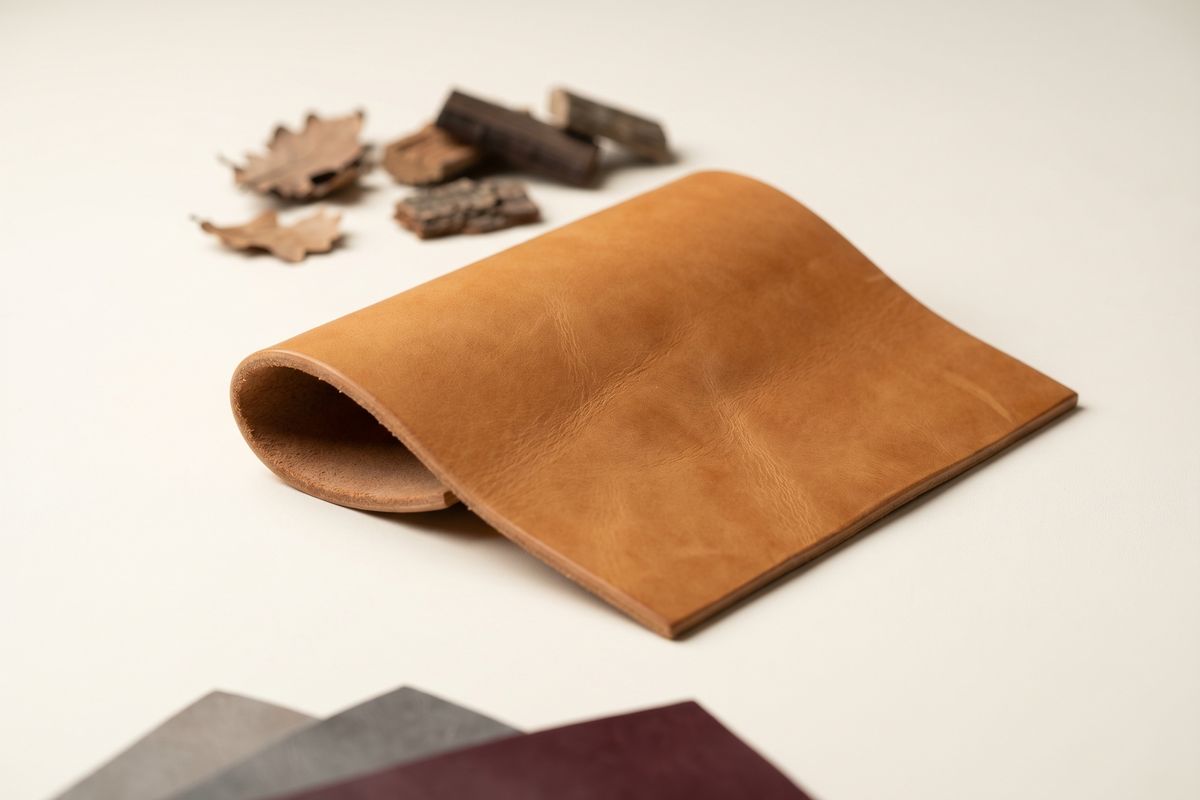
The oldest way to make leather, thousands of years old. Hides soak for weeks in baths of tannins — natural acids drawn from tree bark, wood and leaves (oak, chestnut, mimosa, quebracho). It's patient work, but it produces a firm, warm, honey-to-brown leather that ages beautifully and develops a patina. It's the leather of saddlery, belts and traditional luggage.

The fast, modern tannage — soft, supple, resilient.
Invented in the late 1800s and now the workhorse of the industry. Instead of bark, hides are tanned with chromium salts inside rotating drums. It's quick — a day rather than weeks — and gives a soft, flexible leather that stands up to heat and moisture. The great majority of upholstery, automotive, aviation and marine leather is chrome-tanned.
Chrome-tanned but not yet dyed — pale blue and still damp.
A halfway state. Once a hide is chrome-tanned but before it's coloured or finished, it comes out a soft blue-grey (the colour of the chrome) and it's still wet — hence "wet blue." It's stable enough to store and ship, so hides are often bought and sold in this in-between form and finished elsewhere to order.

The same idea as wet blue, but with no chromium — pale cream instead of blue.
When a chrome-free leather is wanted, hides are tanned with other agents (aldehydes, synthetic tannins, and the like). The result is the same kind of stable, half-finished hide as wet blue, but it comes out a pale cream-white — so it's called "wet white." It's often chosen for applications that ask for chrome-free material.

Tanned and dried, but not yet finished — pale and plain.
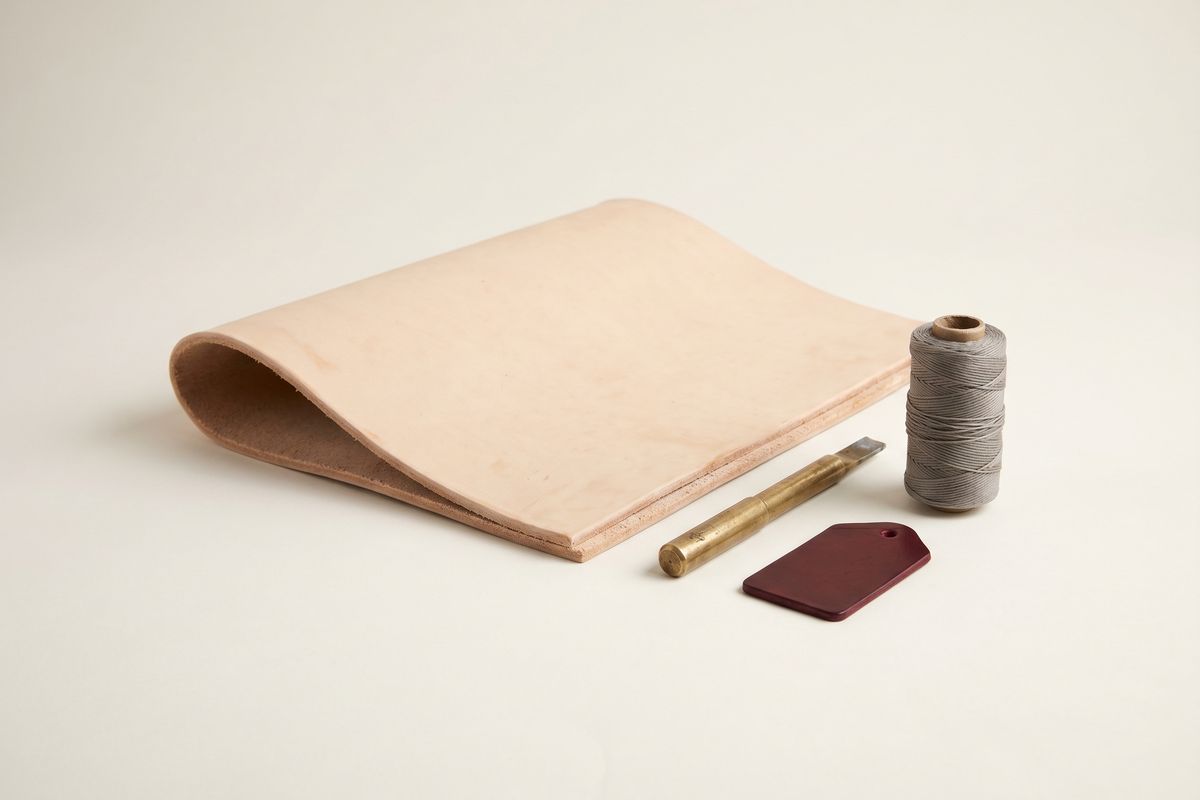
After tanning (and often dyeing) the leather can be dried into "crust" — a stable, semi-finished hide that's stiff, pale and unfinished. Like wet blue and wet white, crust is a tradeable in-between stage: it stores and ships well, then gets softened, coloured and finished to order. Much of the world's leather changes hands as crust.

A second, lighter tannage that dials in the final character.
After the first tannage, a lighter second one fine-tunes the leather — its firmness, fullness, how round it feels, and how it takes dye and finish. Retanning is where a tanner sets the final hand: two hides with the same first tannage can end up very different depending on how they're retanned. It's the quiet step that defines a leather's personality.
Once a hide is tanned and dyed, how its surface is treated decides how it looks, feels and wears. This is where the familiar names come from — aniline, nubuck, suede. Most of it comes down to one question: how much of the natural grain is left alone, versus covered up?
How much of the hide's natural top surface is kept.
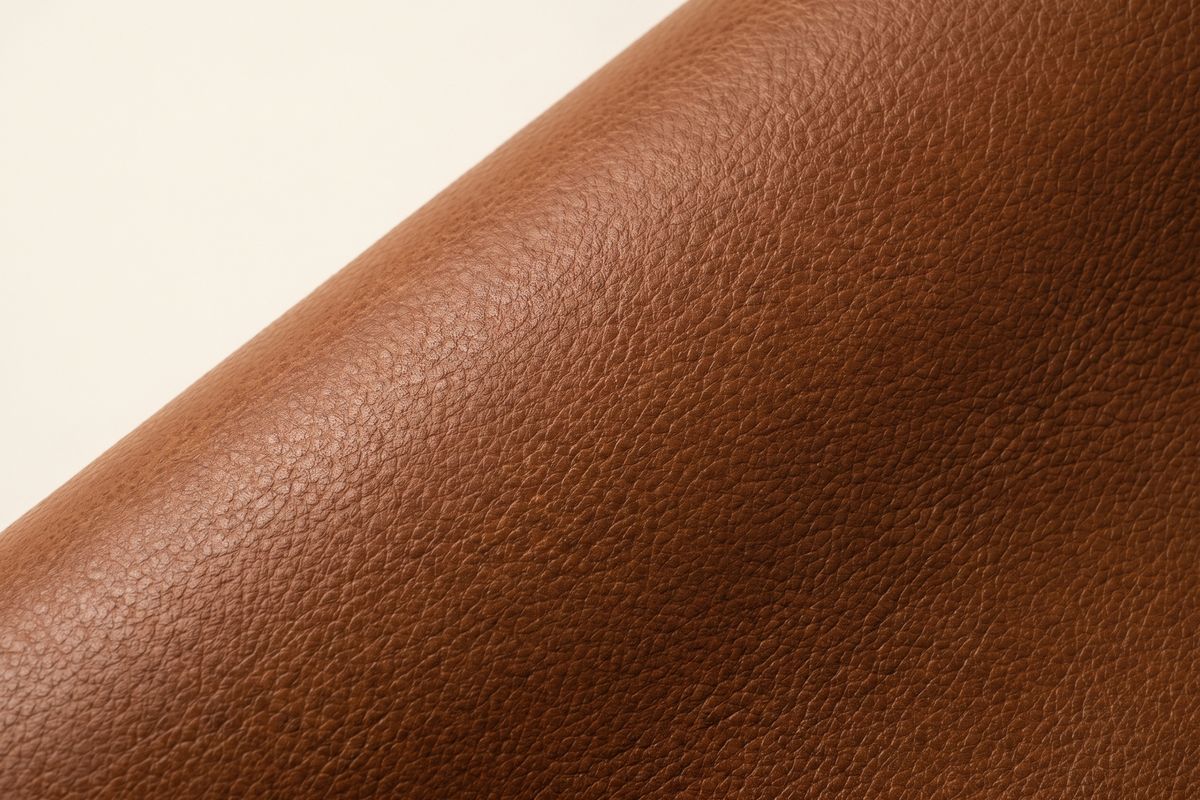
Full-grain leaves the natural outer surface completely untouched — the strongest, most characterful leather, marks and all. Top-grain has that surface lightly sanded to even out blemishes, then often re-textured. Both use the prized outer (grain) layer of the hide; the difference is simply how much it's been corrected.
The hide's own surface, left on show — pores, marks and all.
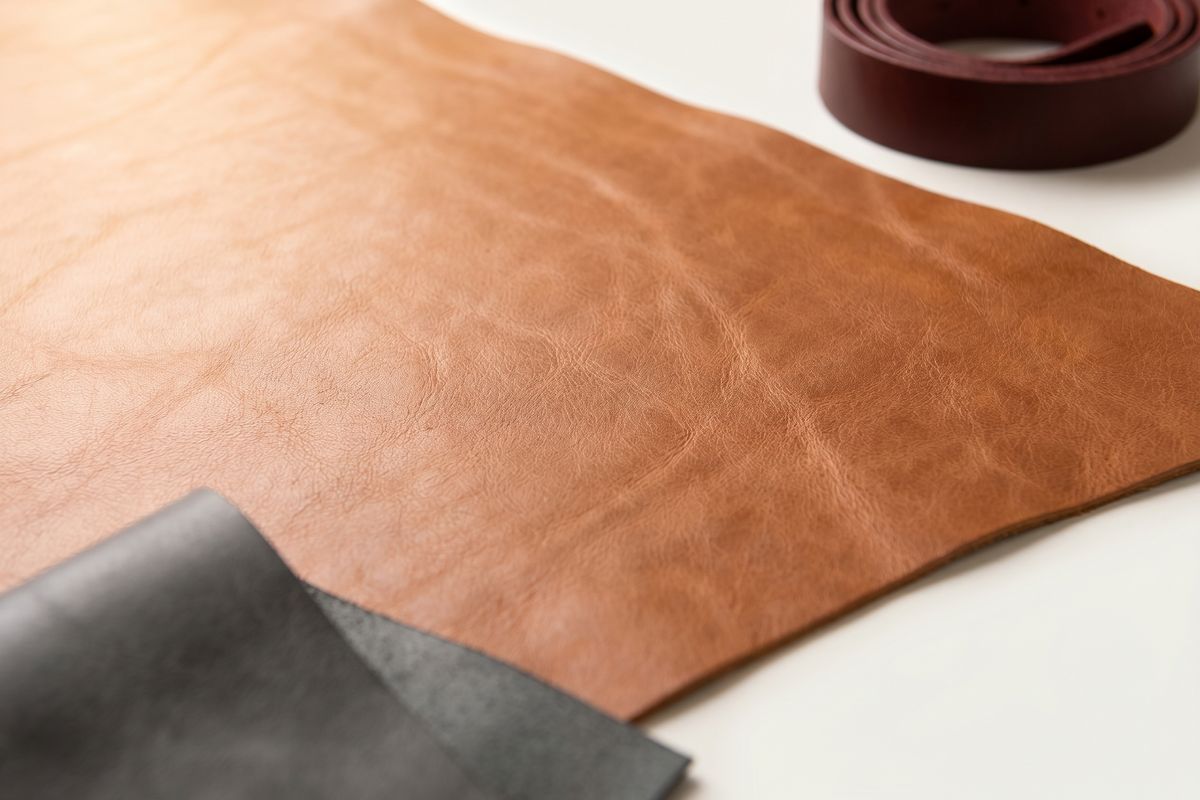
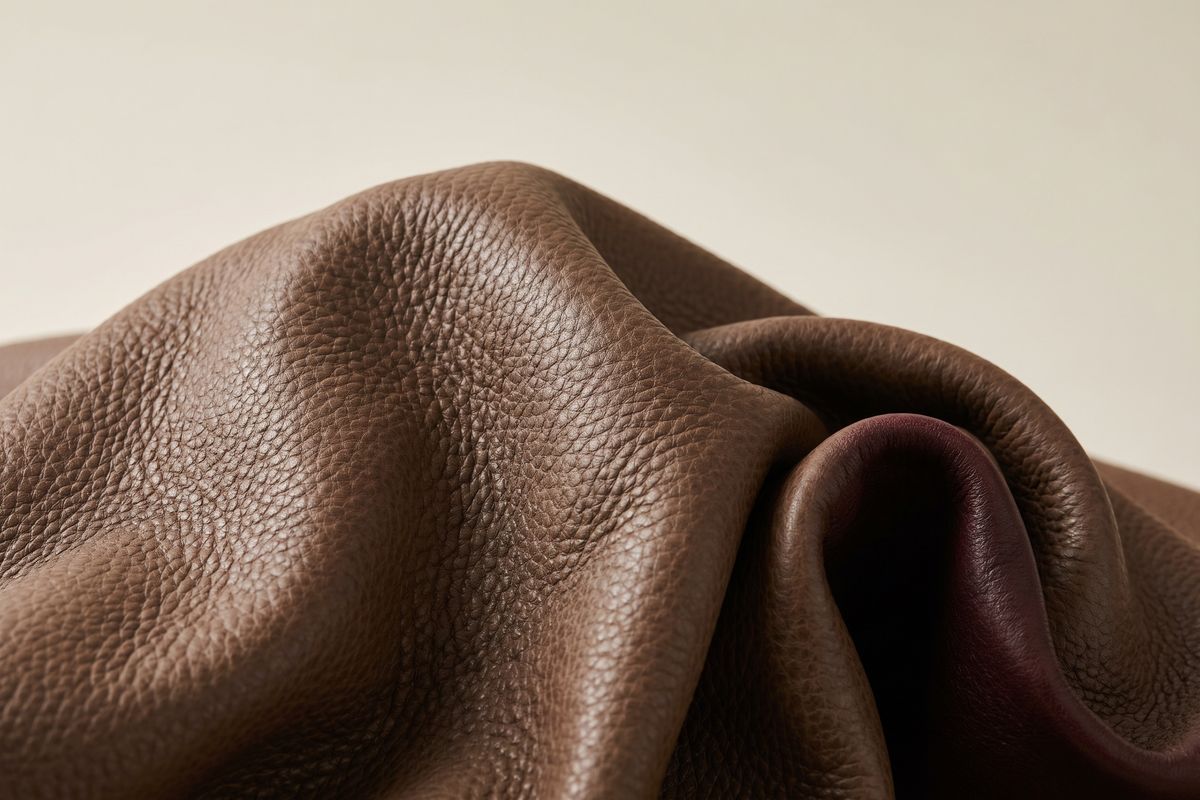
Natural grain is exactly what it sounds like: the leather's real, original surface, kept as it grew. You can see the fine pore pattern, the occasional healed scratch or insect mark, and the gentle variation from one part of the hide to another. Full-grain (completely untouched) and lightly-finished top-grain are both natural-grain leathers.
It's the honest, characterful look — every piece a little different, no two identical — and it only works on good, clean hides, because nothing is there to disguise a flaw. It is the opposite of corrected grain.

The natural surface sanded away and a new grain printed on.
The opposite of natural grain. When a hide has too many natural marks to sell on its own surface, that surface is sanded back, then given a fresh embossed grain pattern and a protective finish. The result is uniform and forgiving — and it puts hides to good use that would otherwise be downgraded — at the cost of some natural character. Most heavily-finished, pigmented leathers are corrected grain.

Coloured with transparent dye only — the most natural look, the least protection.
Aniline leather is coloured like a wood stain rather than paint: a transparent dye soaks in and the surface is left bare, with little or no coating. You see the real grain — pores, healed scars, natural variation — and it feels wonderfully soft and warm. The trade-off is that, with nothing on top, it marks, stains and fades more readily. It's the connoisseur's choice.

Aniline's natural look, with a little armour.
The middle ground, and the most popular choice for fine seating. The leather is aniline-dyed for depth, then given a very light pigmented topcoat. You keep most of the natural grain and softness, but gain a thin layer of protection and more consistent colour — a practical balance of beauty and durability.

An opaque colour coat on the surface — the toughest and most uniform.
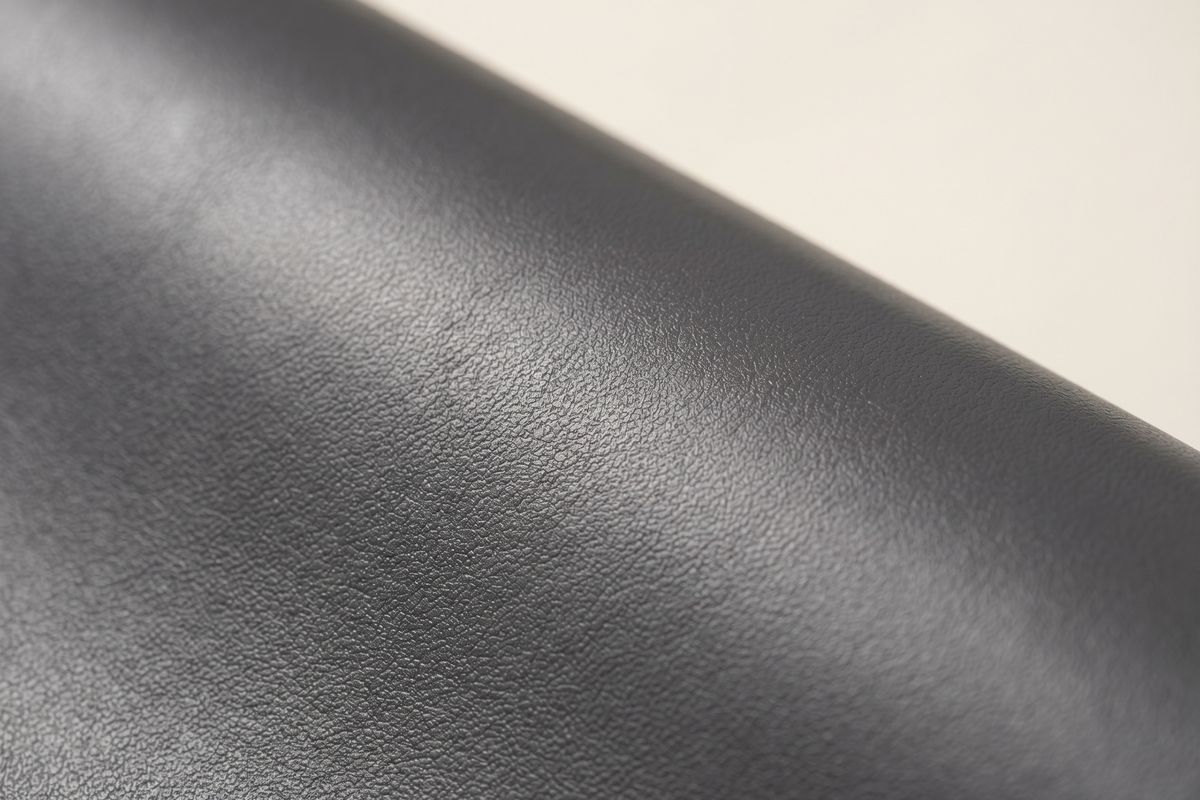
Here a coloured coat (pigment — essentially a fine, leather-friendly paint) sits on top, usually over an embossed grain pattern for consistency. It hides natural variation and resists wear, scuffs and light far better than aniline. This is the standard for cars, aircraft cabins and any high-traffic seating, where every panel has to match and last.

Less a strict category than a promise of softness.
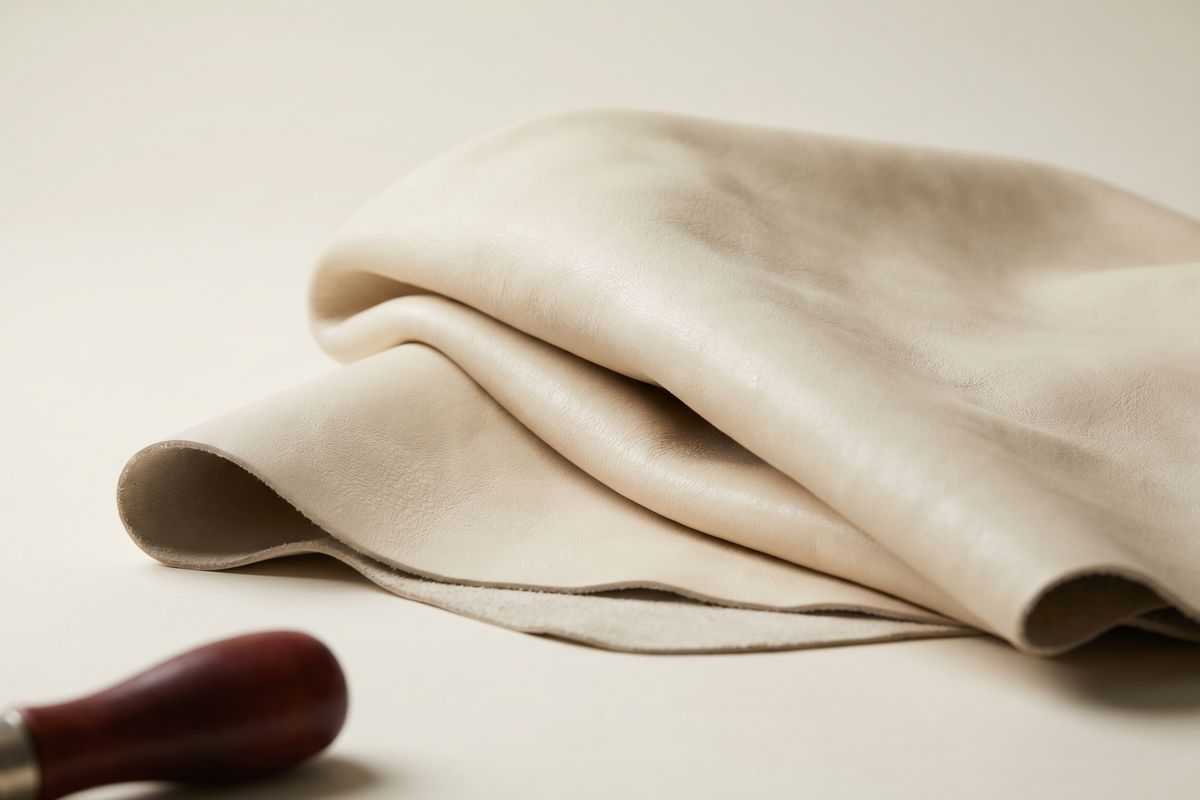
"Nappa" is a catch-all name for soft, smooth, supple full- or top-grain leather — typically chrome-tanned and aniline or semi-aniline dyed. There's no single technical definition; the word signals a butter-soft hand. It's the leather of luxury seating, fine handbags and glove-soft upholstery.

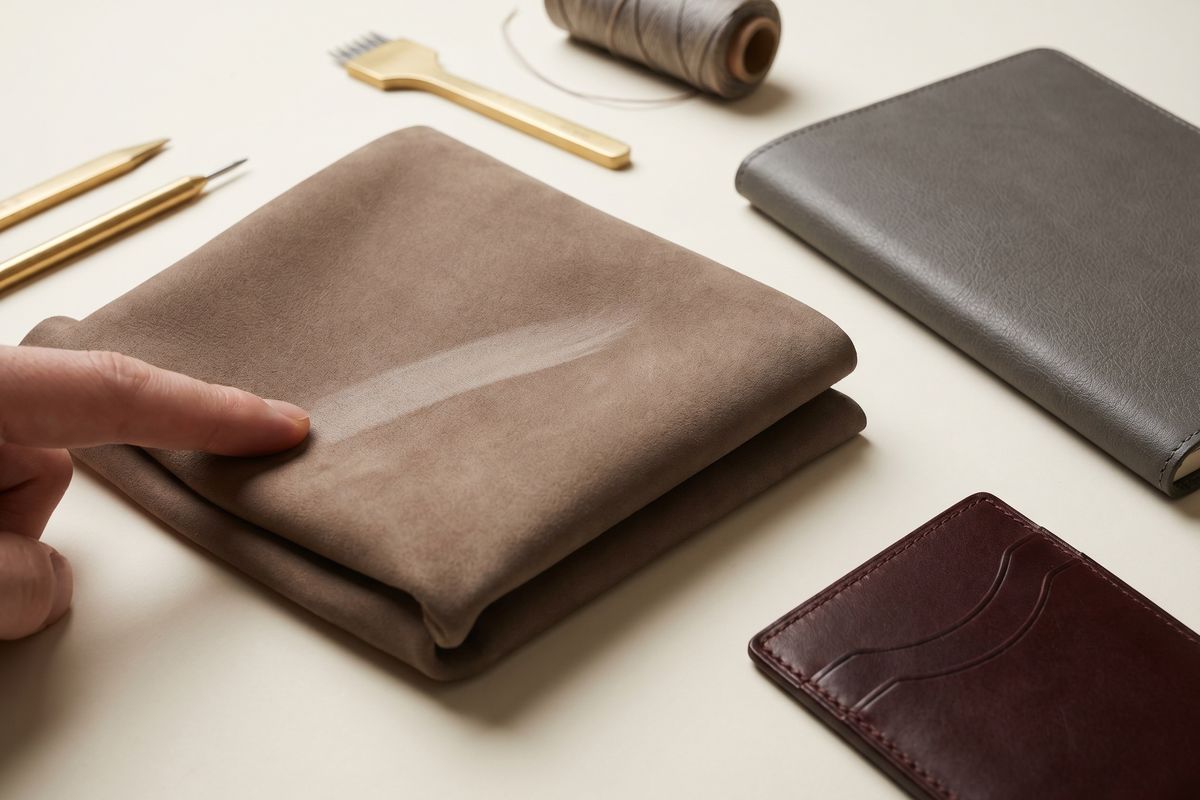
Bend it and the colour lightens at the fold.
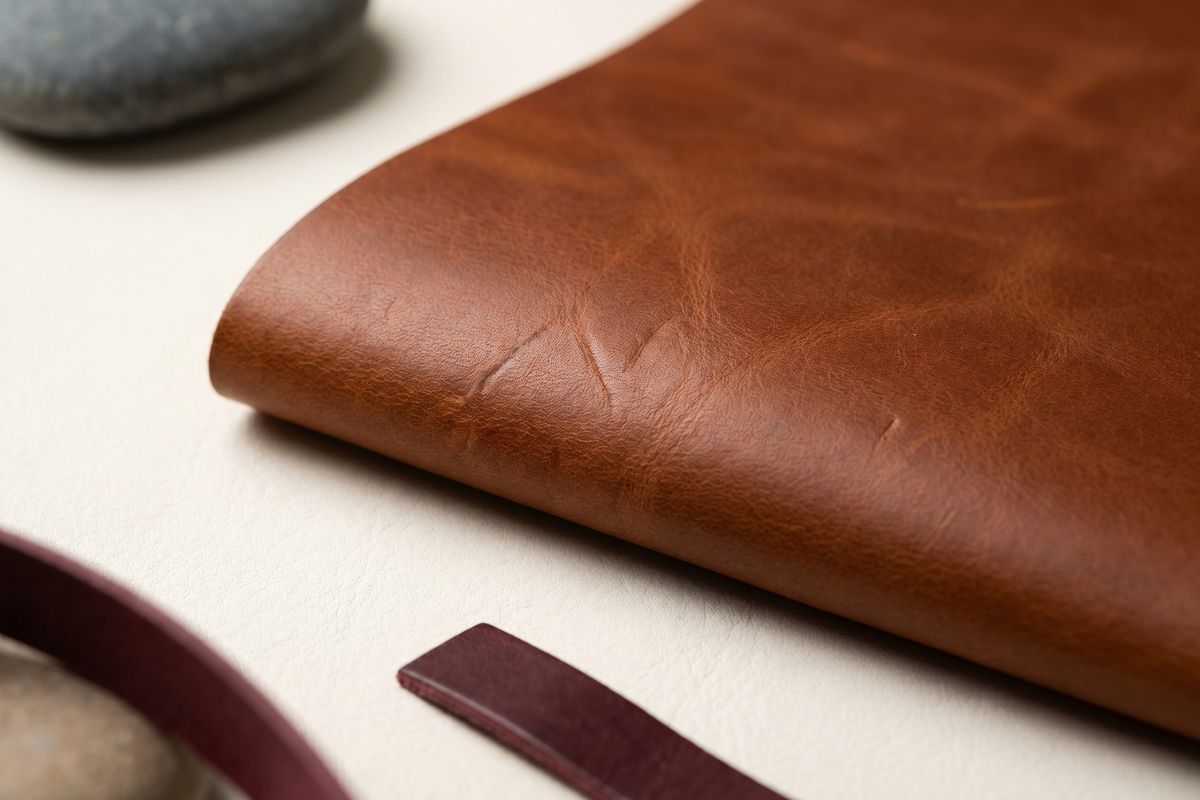
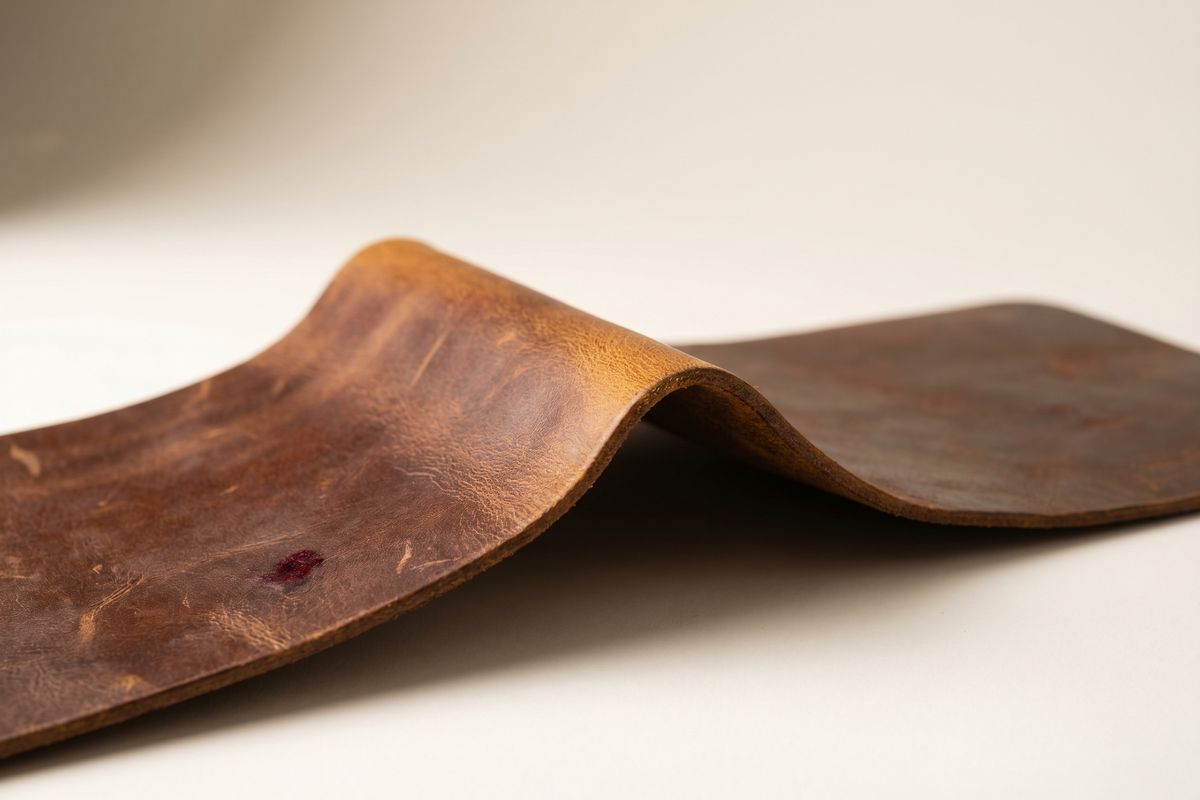
Pull-up leather is loaded with oils and waxes, so when you stretch or fold it the colour lightens right at the bend — the "pull-up" effect. It gives a rich, worn-in, vintage look that only deepens with use and handles scuffs gracefully (a rub often blends back in). Aniline by nature, so it lives and patinas freely.

Colour all the way through, not just on the surface.
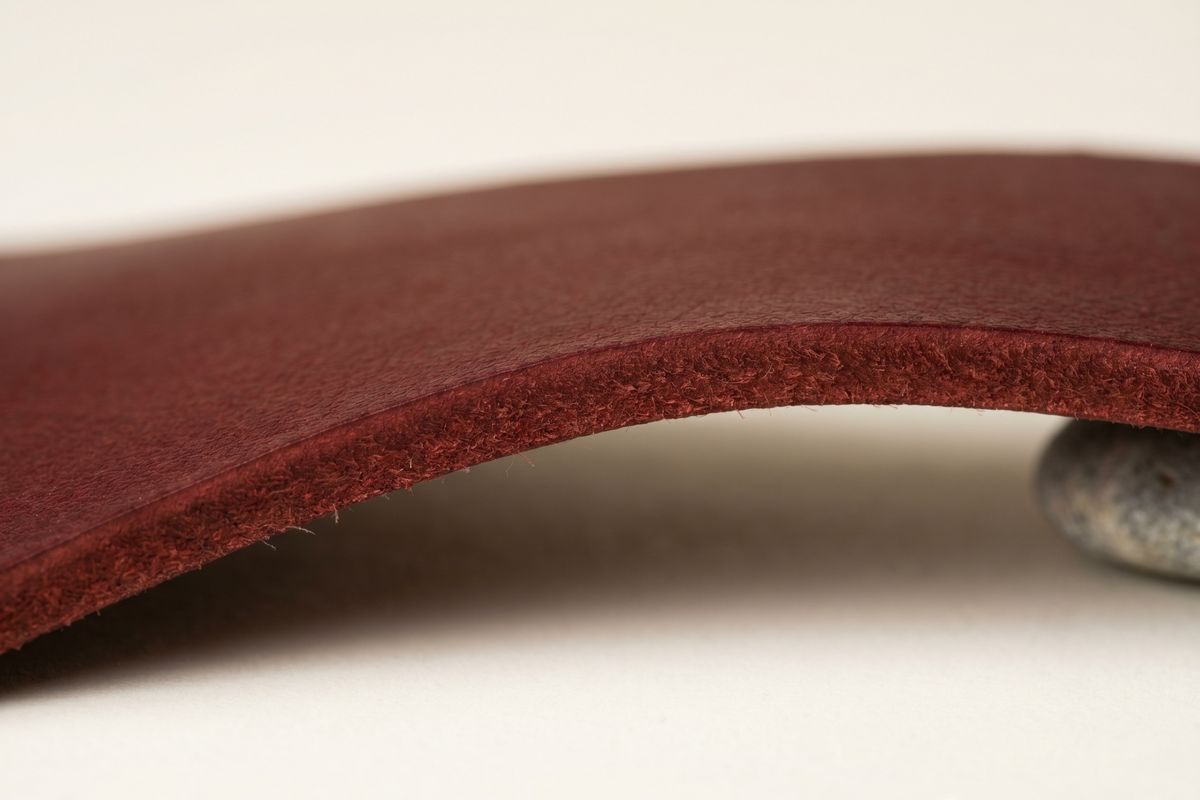
When a hide is dyed right through in the drum, the colour is the same in the middle as it is on the face. Cut an edge or take a deep scratch and you see the same tone — no pale core showing through. It's prized for edges left raw and for hard-used pieces where a scuff shouldn't flash a different colour.

A split given a glossy plastic skin.
Bicast takes a split (or a lower grade of leather) and bonds a glossy polyurethane layer on top, usually embossed with a grain. It looks sleek and uniform and wipes clean easily — but the surface is essentially a plastic film over leather, and over years it can crack or peel. Common in budget furniture and some footwear; worth recognising for what it is.
A mirror-bright, glassy surface.
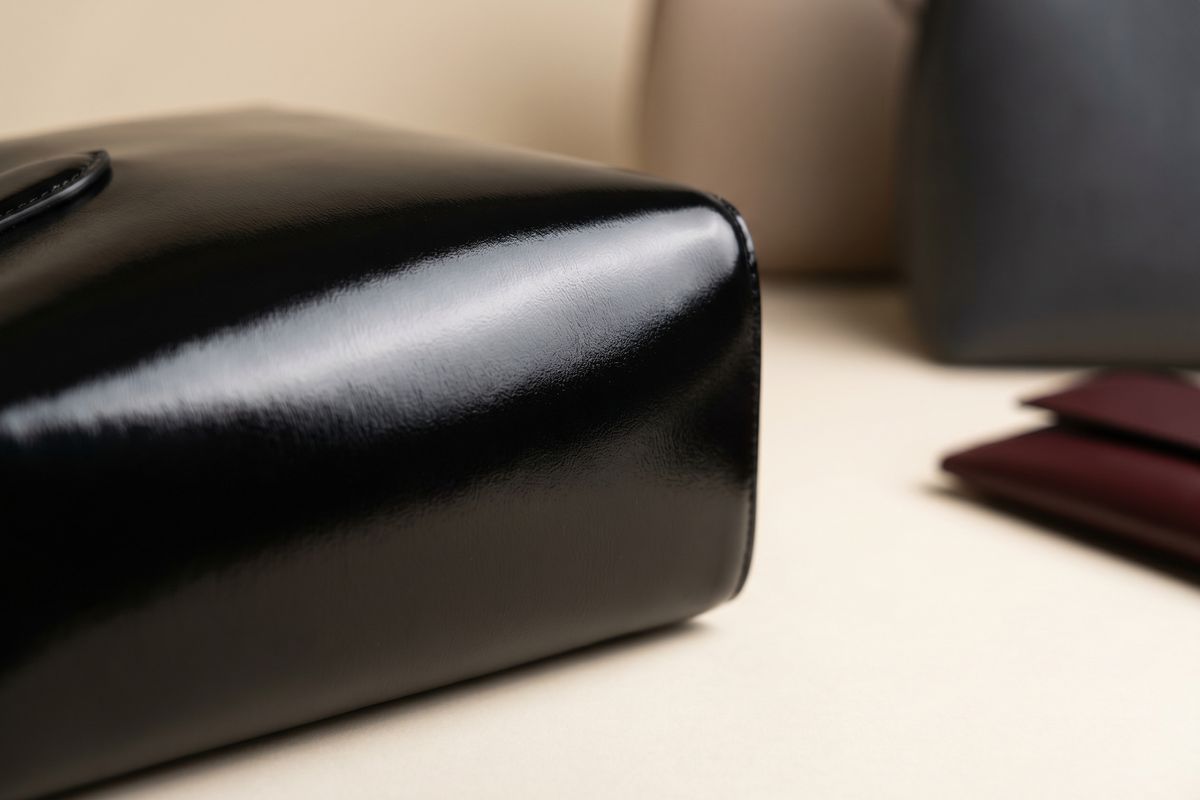
Patent leather wears a high-gloss, almost mirror-like coating (originally lacquer, now usually polyurethane). It's sleek, glassy and water-resistant — the shine of dress shoes and evening handbags. The whole effect lives in that thin, brilliant surface film.

The strong grain side, buffed to a fine velvet.
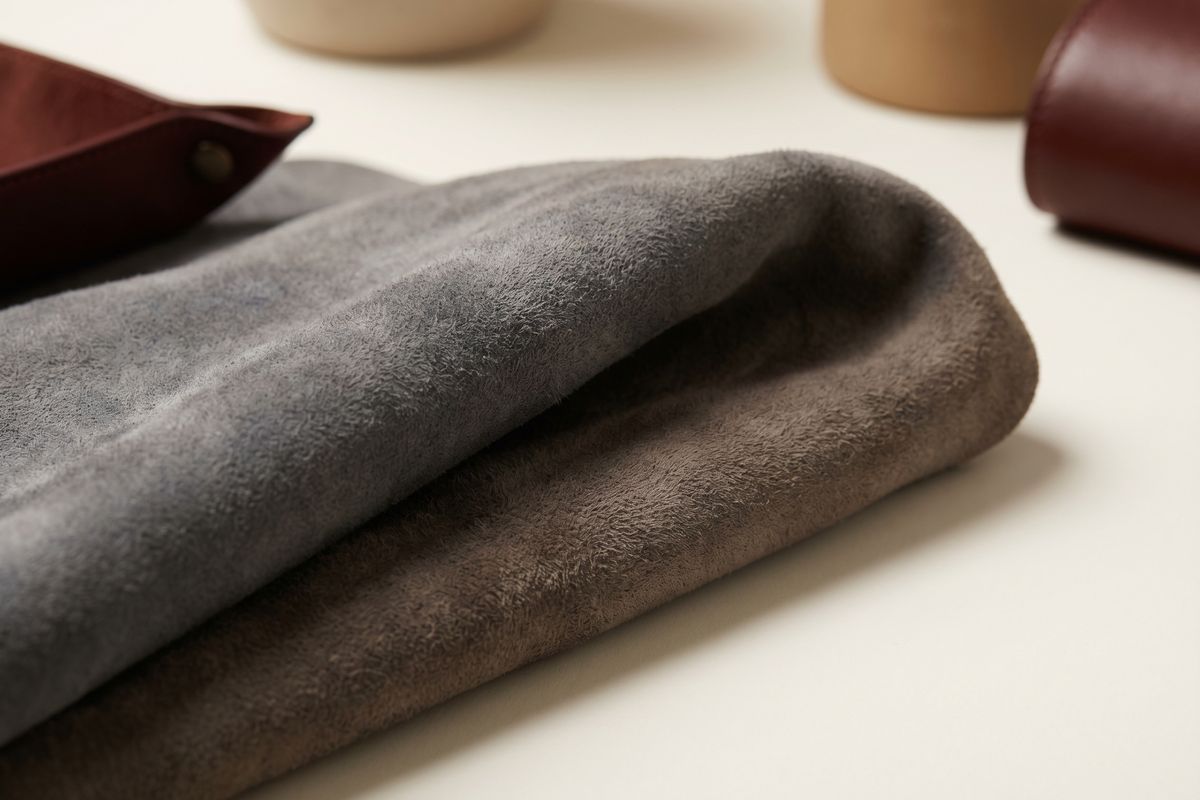
Nubuck is top-grain leather whose outer surface has been lightly sanded to raise a short, fine, velvety nap. It feels soft and luxurious and shows a subtle "writing" effect when you brush it one way or the other. Because it's still the tough outer (grain) layer, it's more hard-wearing than it looks — though, like all napped leathers, it takes marks and water more easily than a coated finish.

The underside, napped — softer and fuzzier than nubuck.
Suede is made from the inner side of the hide (the flesh side) or from a split layer beneath the grain, sanded into a taller, softer, fuzzier nap. It's light and supple and drapes well, which is why it's loved for garments and linings — but it's less durable than nubuck and more open to stains. The nap is deeper and more obviously "fluffy."

Same fuzzy feel, different layer of the hide.
They get mixed up because both are napped. The difference is which layer you're touching. Nubuck is the hide's tough outer grain, sanded just enough to raise a short, fine nap — finer and more durable. Suede is the inner split, sanded into a taller, softer nap — fluffier but more delicate. The rule of thumb: nubuck is finer and stronger; suede is fuzzier and softer.
Between tanning and the finished roll, leather spends time in machines that change its thickness, softness and surface. None of it is glamorous — but it's where a flat, stiff hide becomes the supple material you recognise.
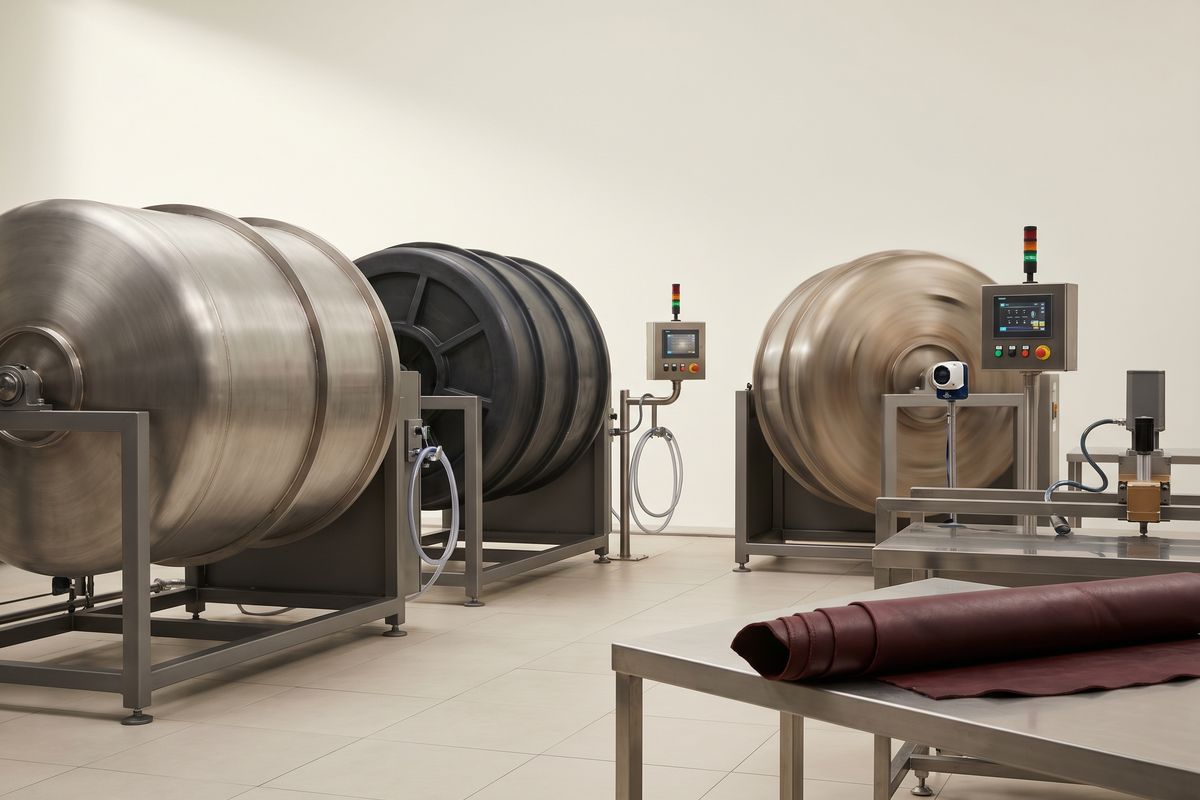
Room-sized rotating barrels where most of the wet work happens.
The giant wooden barrels at the heart of every tannery — picture a wine barrel the size of a room, turning slowly on its side. Hides tumble inside with water, tanning agents, dyes or oils. Nearly every wet step — tanning, dyeing, feeding in oils — happens in a drum, and how long a hide turns inside changes everything about the final feel.

Slicing a thick hide into layers while it's still wet.
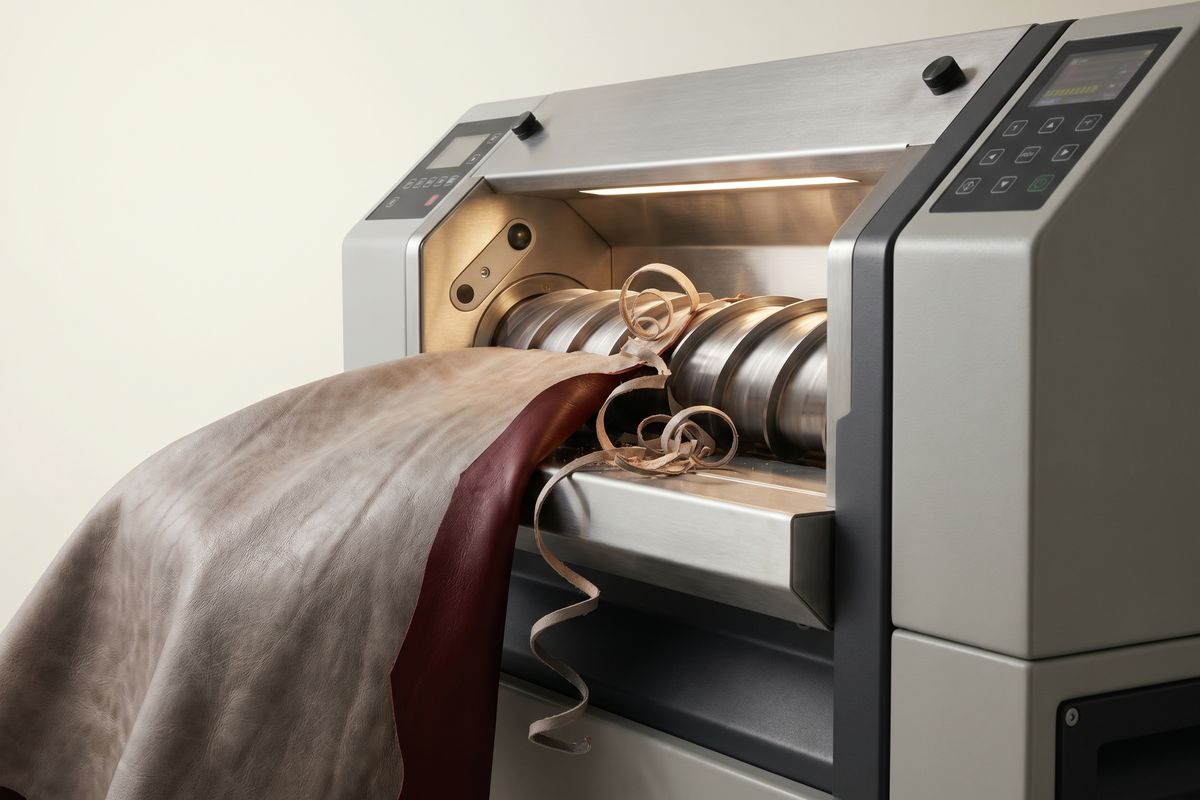
A thick hide is fed through a splitting machine — a long, fast band-knife — that slices it horizontally into layers. The top layer keeps the natural grain (the prime leather); the lower layer is the split, which becomes suede or takes a coating. Doing it wet (at the wet-blue/wet-white stage) is common, because the hide handles cleanly and the thickness can be set early.

Bringing the whole hide to one exact thickness.
After splitting, the flesh side is shaved by a rotating bladed cylinder to level the hide to a precise, even thickness — its "substance." It's fine work measured in tenths of a millimetre: too thin and the leather is weak, too thick and it won't form cleanly to a seat. Shaving is where the final thickness is dialled in.

Tumbling the leather to soften it and bring up the grain.
Milling is tumbling dry (or nearly dry) leather in a drum for hours. The hides flex against themselves and break in — the more milling, the softer the hand and the more pronounced and rounded the natural "pebble" of the grain. It's how a board-stiff hide turns into something that falls into a soft fold.

Working oils into the fibres so the leather stays soft.
During the wet stages, oils and fats are worked deep into the hide. They coat the fibres so they slide past each other instead of sticking together as they dry — which is the difference between supple leather and something stiff as cardboard. It's quiet, invisible, and one of the biggest factors in how a leather feels.
Flexing the dried hide soft — no chemistry, just movement.
Once dried, leather can be stiff. A staking machine flexes and stretches it back and forth, loosening the fibres until the hide drapes softly. It's purely mechanical softening — the difference between a board and a supple, falling hide — and it's tuned to the feel the leather needs.
How the leather is dried changes how it ends up.
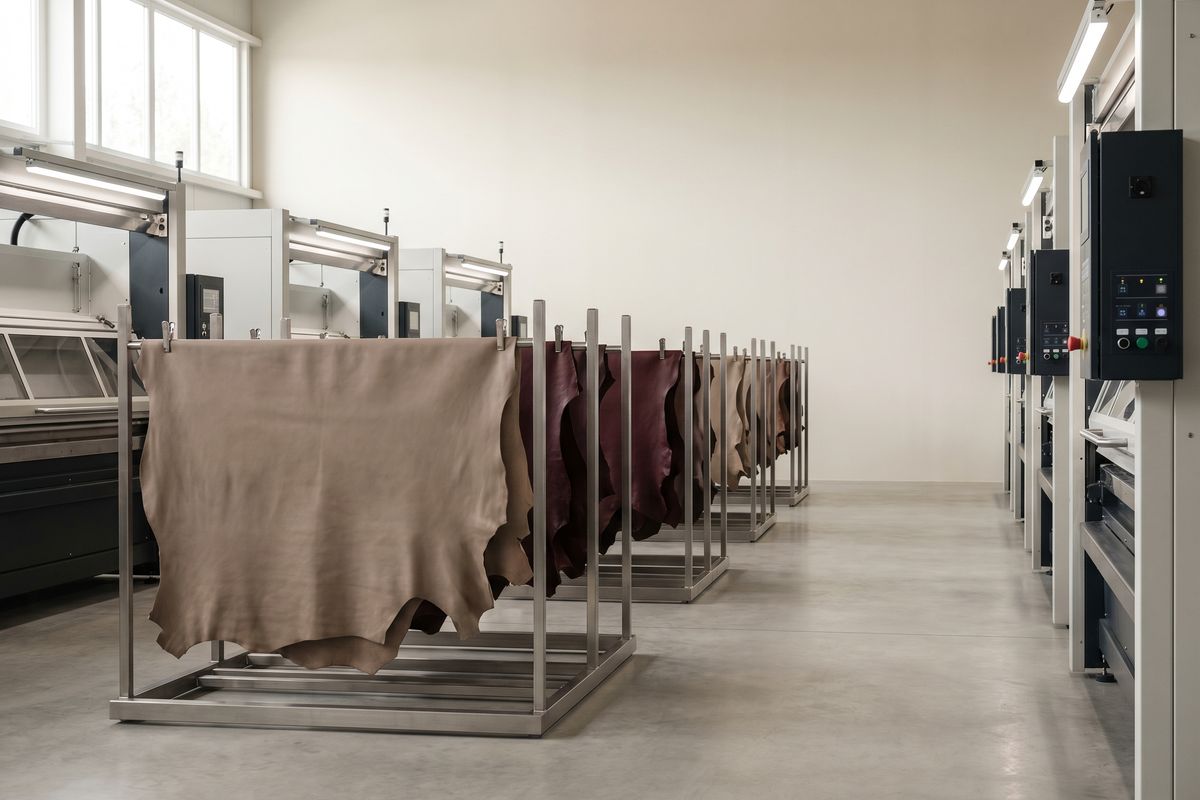
After the wet stages, the leather has to dry — and the method shapes the result. Toggling clips the hide to a frame and stretches it as it air-dries, for area and flatness. Vacuum drying presses it against a heated plate under vacuum — fast, smooth, with a tight grain. Tanners choose the method to suit the leather they want.

Sanding the surface — lightly to clean it up, harder to make nubuck.
Buffing runs the leather against abrasive rollers. A light pass tidies the grain and removes minor blemishes; a more deliberate pass raises the fine nap that turns top-grain into nubuck. It's the same basic action as sanding wood — the amount is everything.

A filler paste that levels the surface before finishing.
Like the spackle a painter uses before painting a wall, stucco is a paste worked into the surface to fill and smooth small imperfections. It gives an even, stable base so the colour and topcoat that follow lay down cleanly and uniformly. Used mostly on corrected and pigmented leathers.

Pressing the surface smooth — or stamping in a grain.
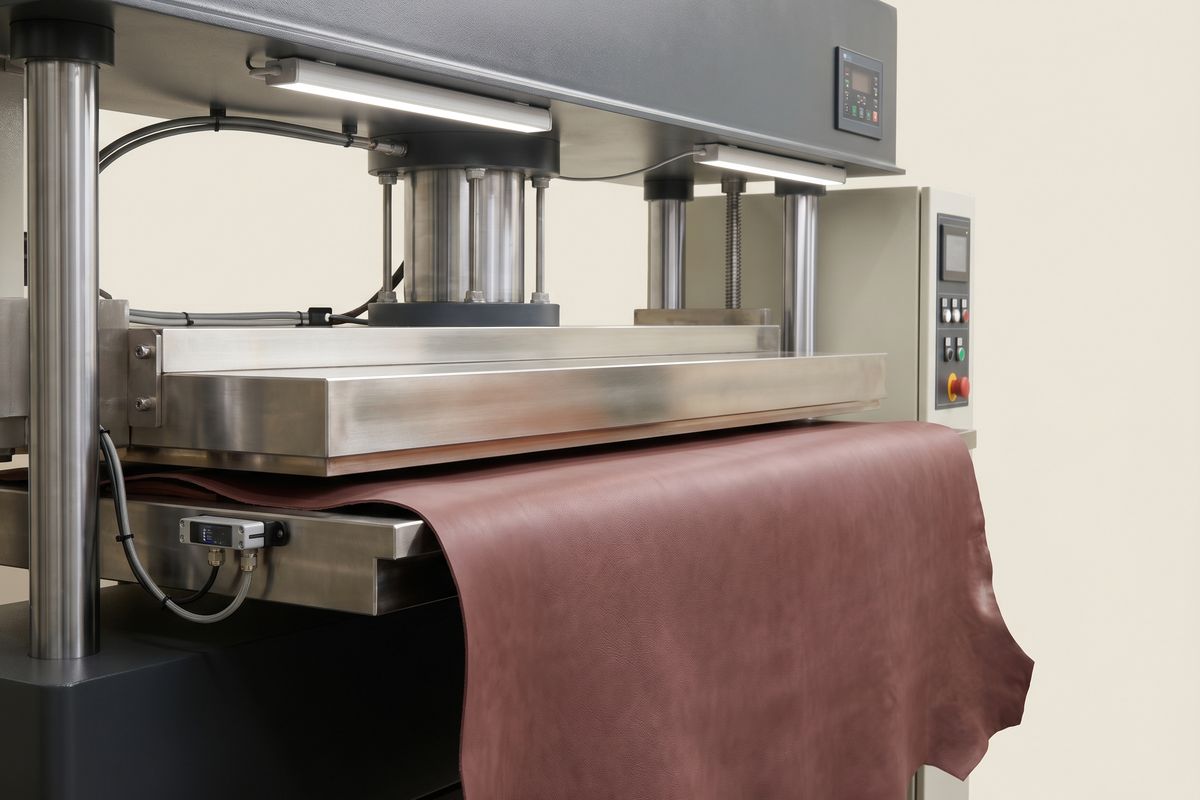
Plating presses the leather under a heated hydraulic plate. A smooth plate gives a sleek, even face; an engraved plate stamps a consistent grain or pattern into the surface. Heat, pressure and time do the work — it's how a finish is set flat, or a uniform grain is printed across every hide.

Opaque colourants that sit on the surface for even, repeatable colour.
Pigments are the colour in a surface finish — very fine, leather-friendly paint. Unlike dyes, which soak in and stay see-through, pigments sit on top and cover what's beneath. That's what lets a pigmented leather hold an exact, uniform colour across thousands of square feet, hide after hide.
Colour coats and topcoats applied with spray guns.
Most finished leathers get their final colour and protective topcoats from spray guns in a booth — often automated, with hides riding through on a conveyor while sensors place each pass. It's how surface colour, sheen and protection are laid down evenly and consistently at scale.

Colour is the first thing anyone notices and the thing most argued over. Here's where it actually comes from, and how the industry pins it to a number — so "the same beige" really is the same beige, this year and next.
Dyes soak in and glow; pigments coat and cover.
There are two ways to colour leather. Dyes are transparent and soak into the fibres in the drum, colouring the hide from within — that inner glow is what gives aniline its depth. Pigments are opaque and sprayed on top for even, repeatable colour. Most leathers use a bit of both: dyed for depth, then finished for consistency and protection.
A machine turns a colour into exact numbers.
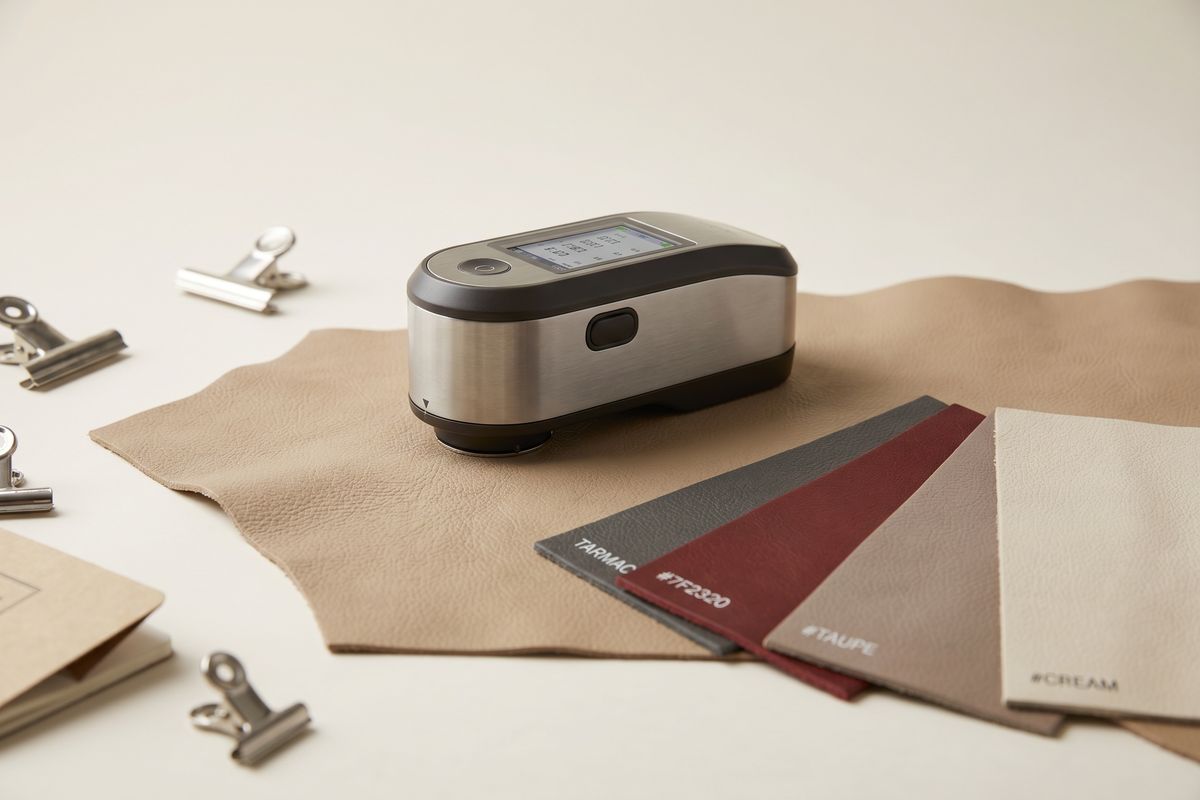
Eyes disagree and lighting plays tricks, so colour isn't judged by eye alone — it's measured with a spectrophotometer, a device that reads precisely how a surface reflects light and converts it into numbers. The common map is L*a*b*: L* is lightness (dark to light), a* runs green to red, b* runs blue to yellow. Every colour becomes one exact coordinate that can be filed, shared and matched.

One number for "how different are these two colours?"
Once two colours are numbers, the distance between them is a single value — Delta E (ΔE). Zero means identical. Around 1 is the point where a trained eye begins to notice a difference at all, so a ΔE under roughly 1 is usually accepted as a match. It's the figure behind a colour guarantee: it's how a house proves this season's hide truly matches the swatch approved two years ago.

Why a match has to be checked under the right light.
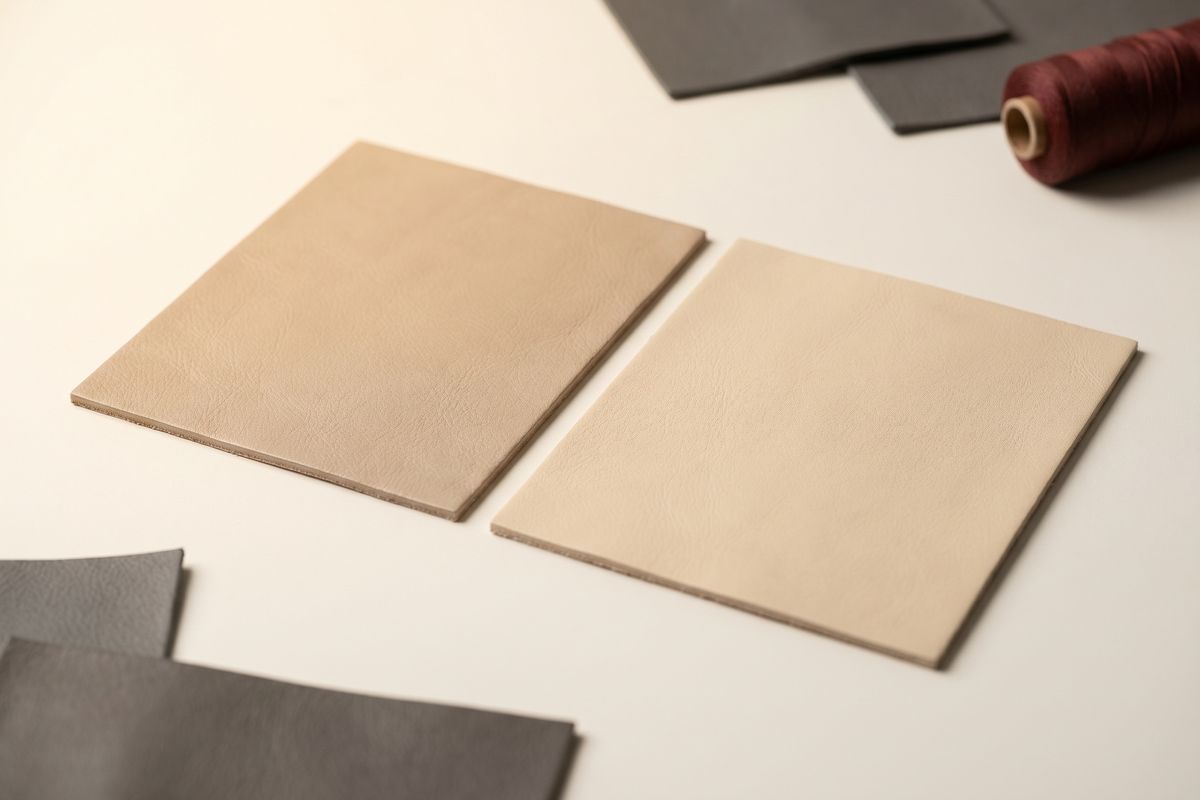
Here's the wrinkle: two colours can match perfectly under one light and clash under another — say, daylight versus a cabin's LED glow. That mismatch is called metamerism, and it's why serious colour matching is done under standard, named light sources (illuminants) rather than whatever's overhead. Specifying the light is part of specifying the colour.
A leather sold for a plane, a car or a yacht has to prove it can take the punishment — and pass the safety rules. These are the tests and certificates behind the spec sheet, in plain terms.
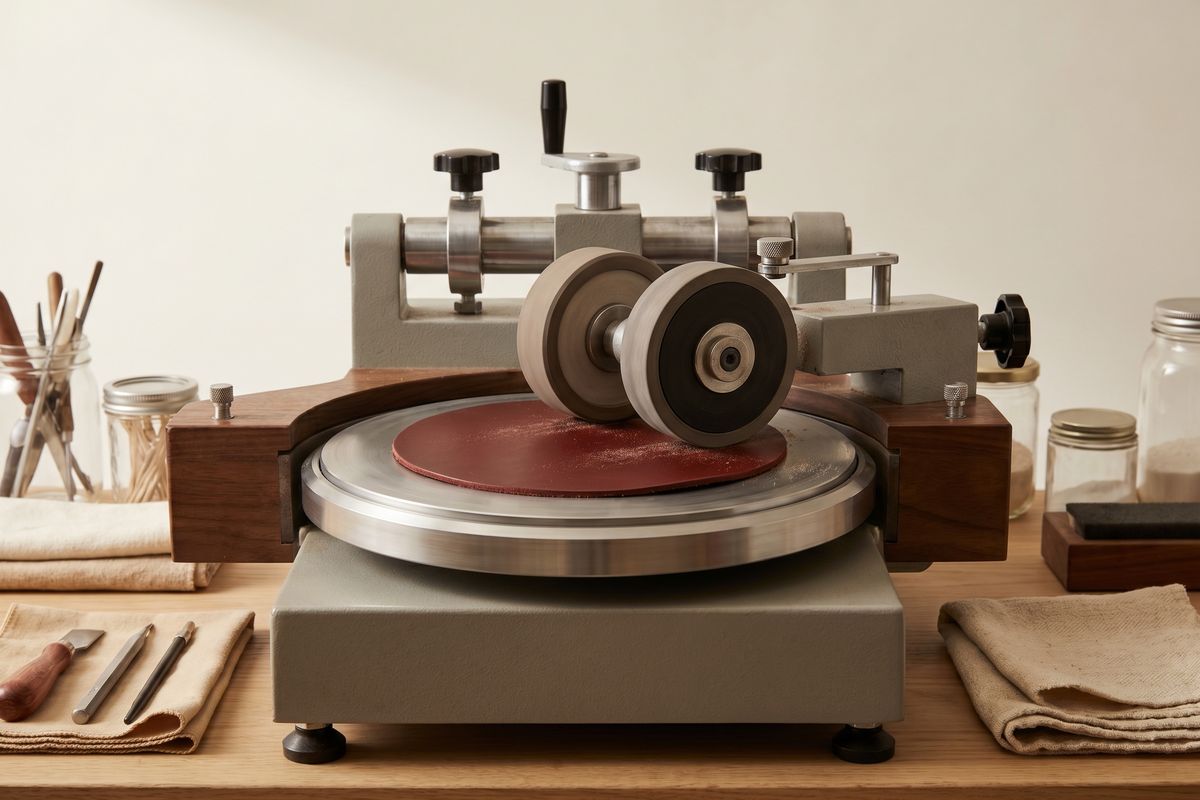
Spinning abrasive wheels measure how well the surface resists wear.
The Taber test answers "how long until it looks worn?" A sample is clamped to a turntable and a pair of weighted abrasive wheels grind against it for thousands of cycles. The more cycles it survives before the finish shows damage, the tougher the leather. Think of it as fast-forwarding through years of elbows, sleeves and sliding in and out of a seat.

Does the colour rub off, wear off, or fade? These tests find out.
A family of checks for whether the colour stays where it belongs. Crocking rubs the surface — dry and wet — to see if colour transfers onto a cloth. Martindale rubs it back and forth tens of thousands of times for upholstery durability. And light-fastness parks it under strong light to see how much it fades. Together they tell you the colour will survive real life, not just the showroom.
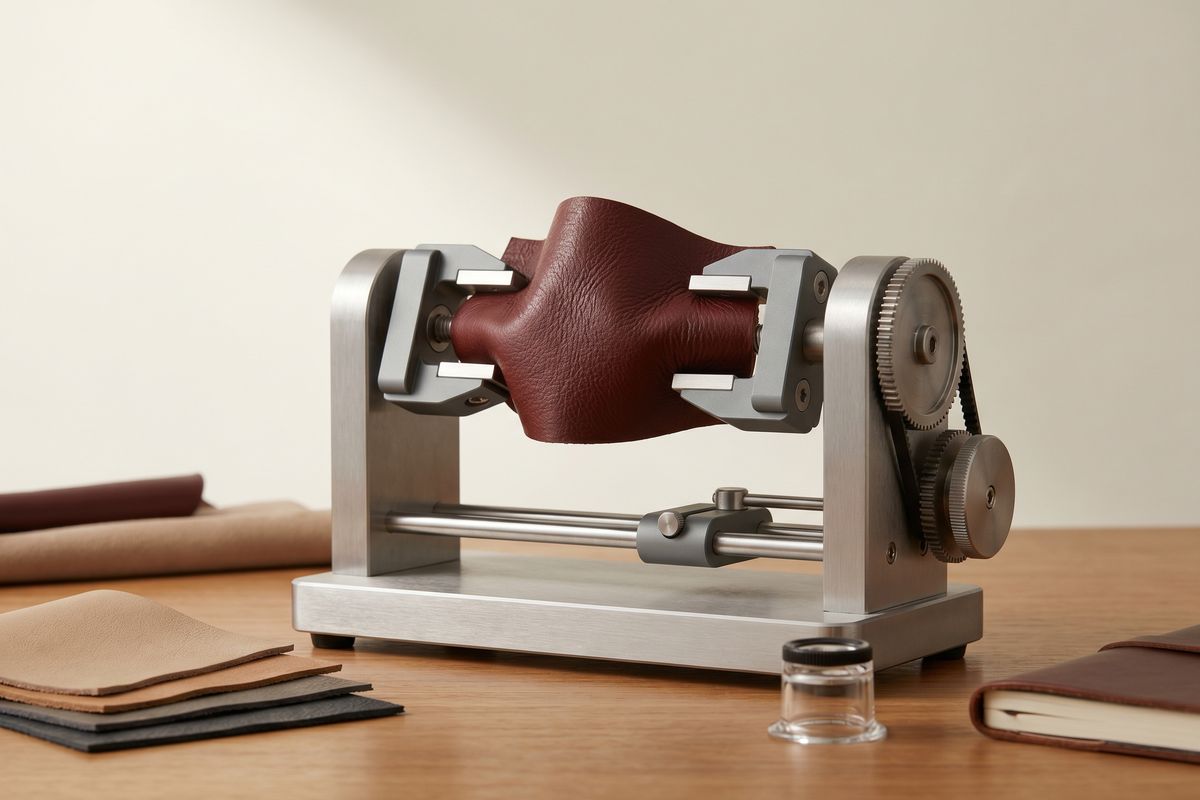
Will the finish crack when it bends — especially when it's cold?
A flexometer folds a sample over and over — tens of thousands of times, and often chilled well below freezing — to make sure the finish doesn't crack, flake or split. It matters anywhere leather bends constantly or lives in the cold: a car door pocket, a folding armrest, an aircraft seat at altitude where the cabin can get genuinely cold.

How hard you can pull before it tears.
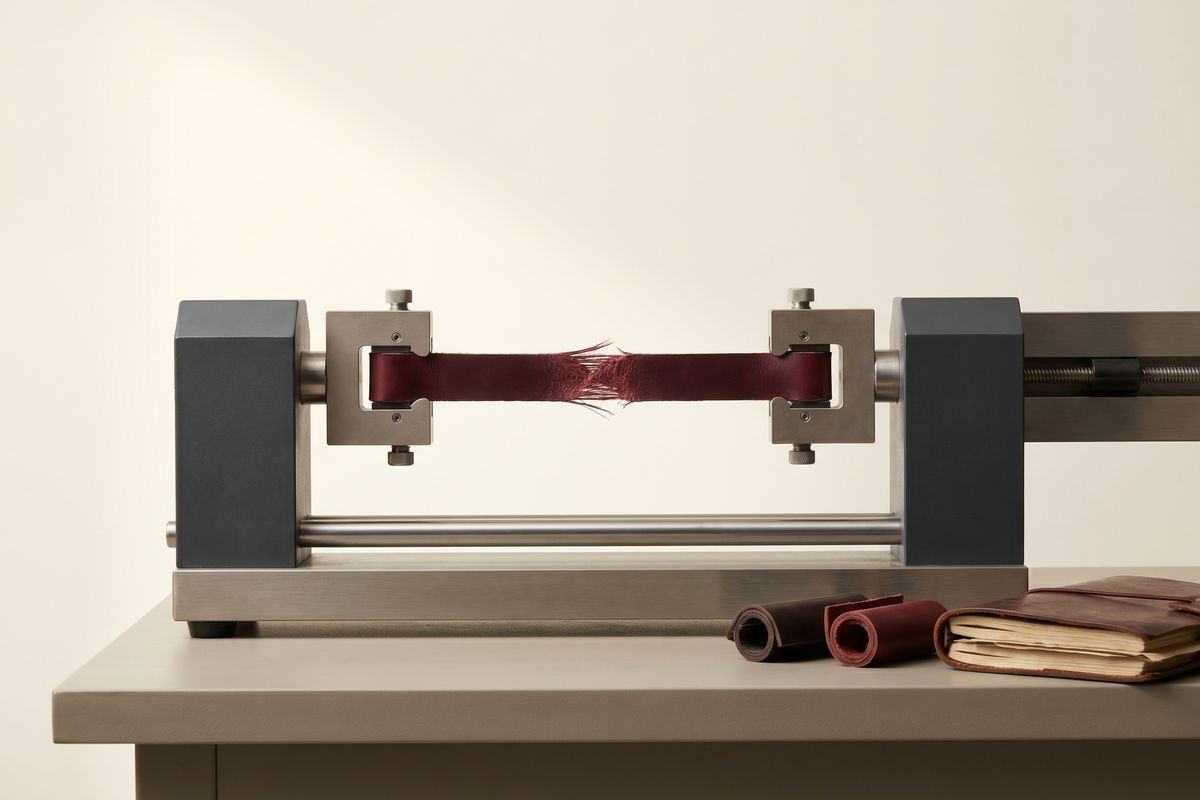
A machine grips a strip of leather and pulls until it fails, measuring the force. Tensile strength is straight-pull resistance; tear strength is how well it resists a tear once one has started. The numbers tell you whether a hide can be stretched tight over a seat frame and stapled down without splitting — and stay intact for years of use.

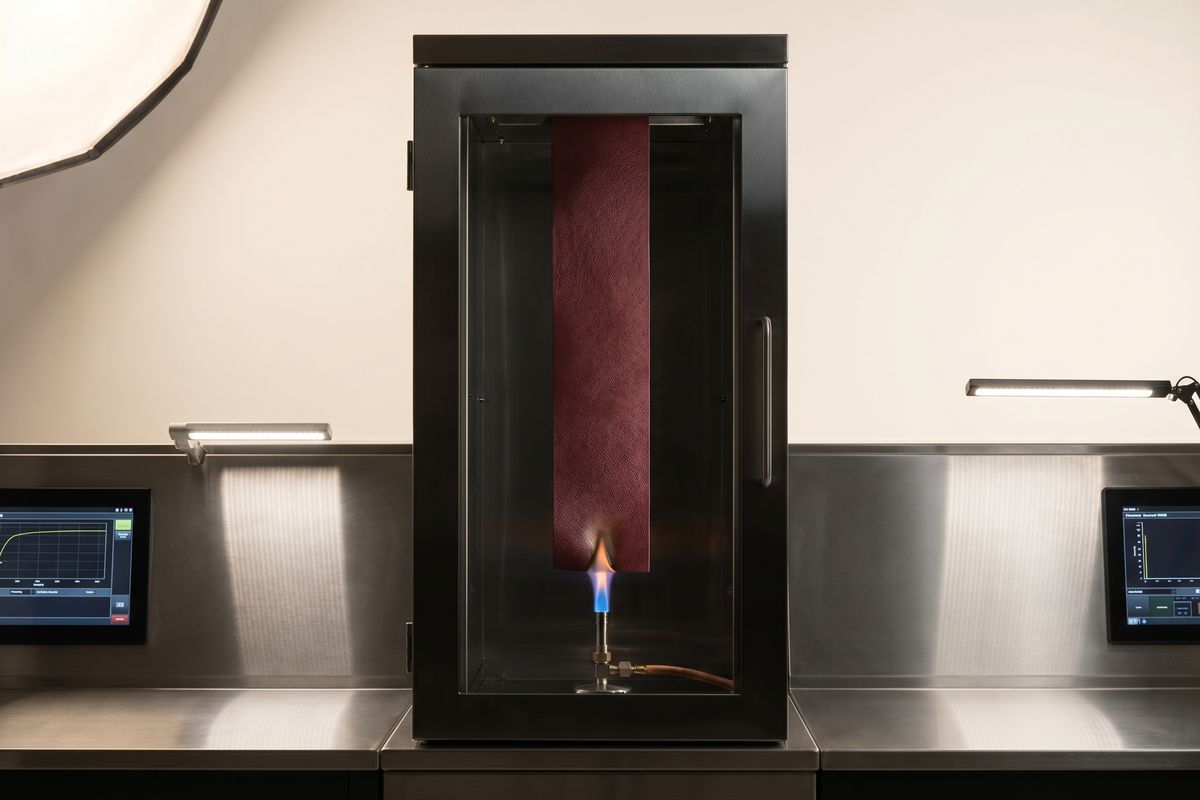
Hold a flame to it for 12 or 60 seconds — it has to put itself out.
Aviation leather must not feed a fire. In the vertical burn test, a sample hangs in a chamber and a flame is held to its bottom edge for a set time — 12 seconds for most cabin materials, 60 seconds for larger or more critical surfaces — then taken away. To pass, the material has to self-extinguish quickly, char only a limited length, and not drip flaming bits. It's the certification behind nearly every leather that flies.

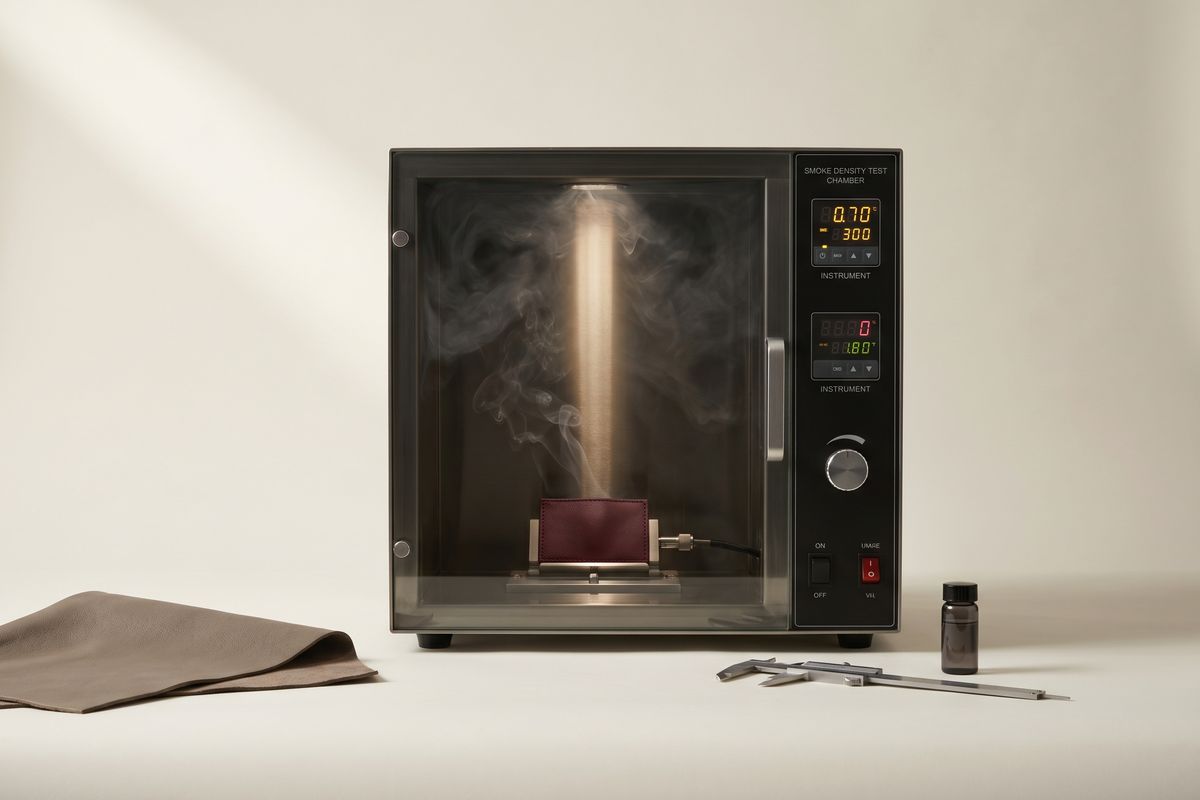
It mustn't just resist flame — it mustn't blind the cabin with smoke.
In a fire, smoke is what stops people finding the exits, so cabin materials are tested for it. A sample is burned inside a sealed chamber and the smoke is measured by how much it blocks a beam of light over the first minutes — the denser the smoke, the worse the score. It's usually paired with a check on how toxic the smoke's gases are. (You may hear it quoted as a pair of pass limits for smoke and toxicity — your spec sets the exact figures.)

Big cabin panels must give off very little heat in a fire.
For the large interior surfaces — sidewalls, ceilings, stowage bins — self-extinguishing isn't enough; the surface must also release very little heat while it's exposed to fire, so it doesn't help a fire grow. The OSU test measures that, and the well-known aviation limit is "65/65" — a cap on both the peak and the total heat released in the first two minutes. Leather facings on those panels have to fit inside it.
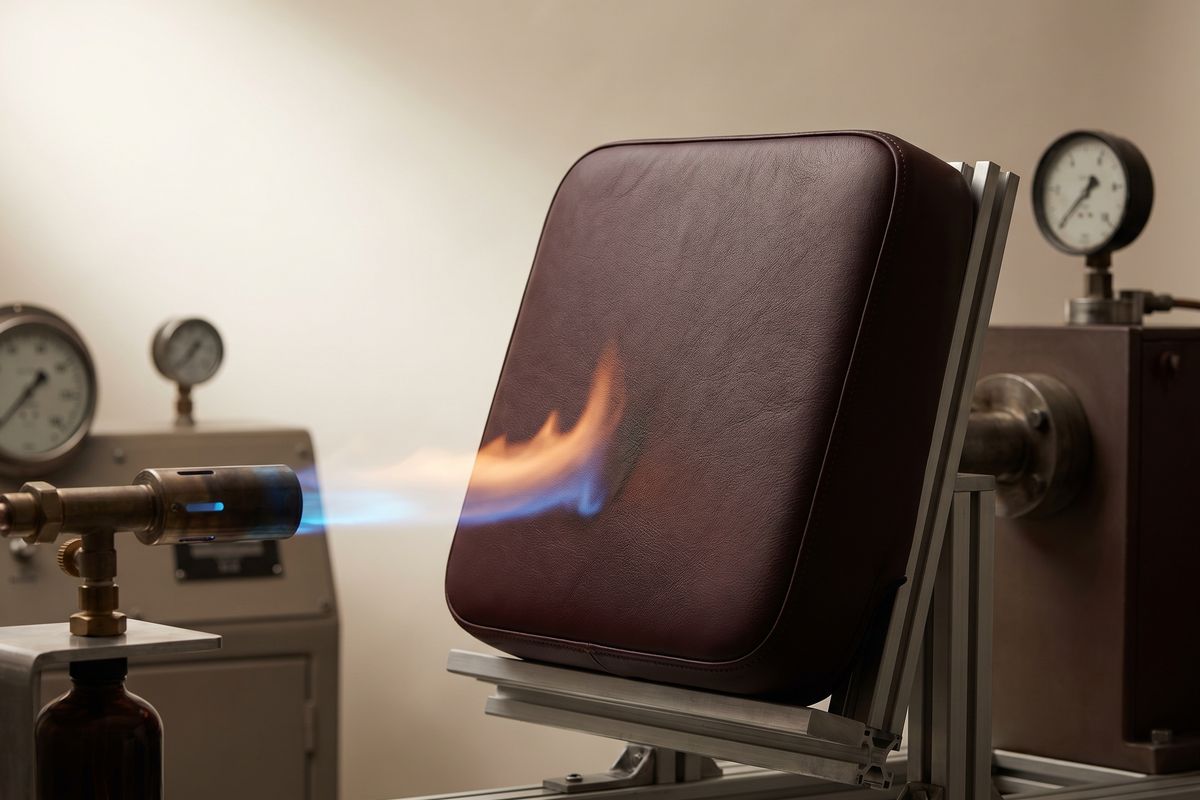
A simulated fuel fire — the seat has to hold out long enough to matter.
A tougher fire test, aimed at seat cushions. An oil (kerosene) burner blasts a fierce, steady flame at the cushion assembly to mimic a real post-crash pool fire. The leather-and-foam build has to resist burn-through for a required time, buying passengers precious seconds to evacuate. This is the "fire-block" requirement, and it's why cabin seats are engineered as a fire-resisting sandwich, not just a cover.

Why the windscreen mustn't haze up from the dashboard.
Ever seen a faint film build on the inside of a car windscreen? That's volatile compounds escaping warm interior materials and condensing on the cool glass — "fogging." Automotive leather is tested for it (a sample is heated in a sealed cup and the haze it casts onto a cold plate is measured) to keep the glass clear and the cabin air clean.
Built and salt-tested to survive sun, spray and sea air.
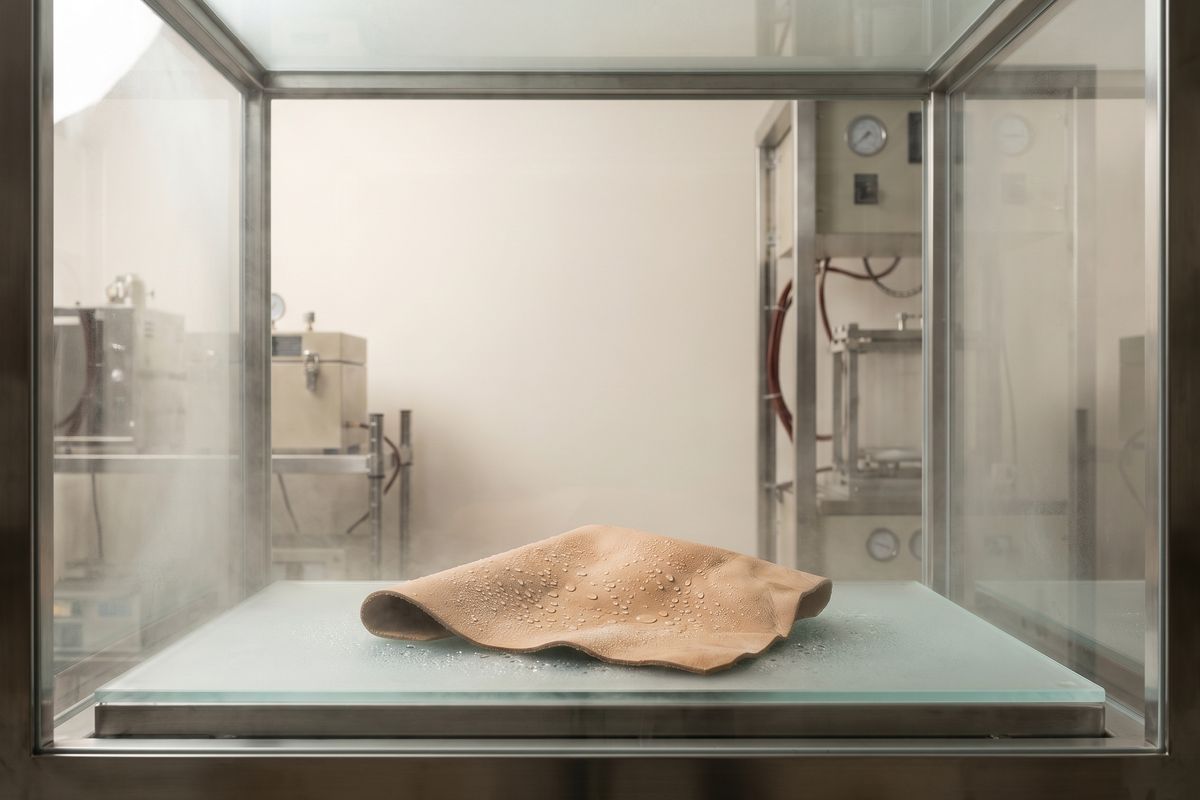
Marine leather lives a hard life — salt, relentless sun, and constant damp. Yacht-grade leather is built for it and proven in a salt-spray (salt-fog) chamber, where samples are bathed in a fine saltwater mist for hours or days to check for staining, stiffening and finish breakdown. It's paired with heavy UV and water-resistance testing so a cockpit seat still looks and feels right after seasons in the weather.

A little of the trade's plumbing — how leather is measured, sold and described — so the figures on a spec sheet or an invoice make sense.
Leather is sold by area, not by the piece.
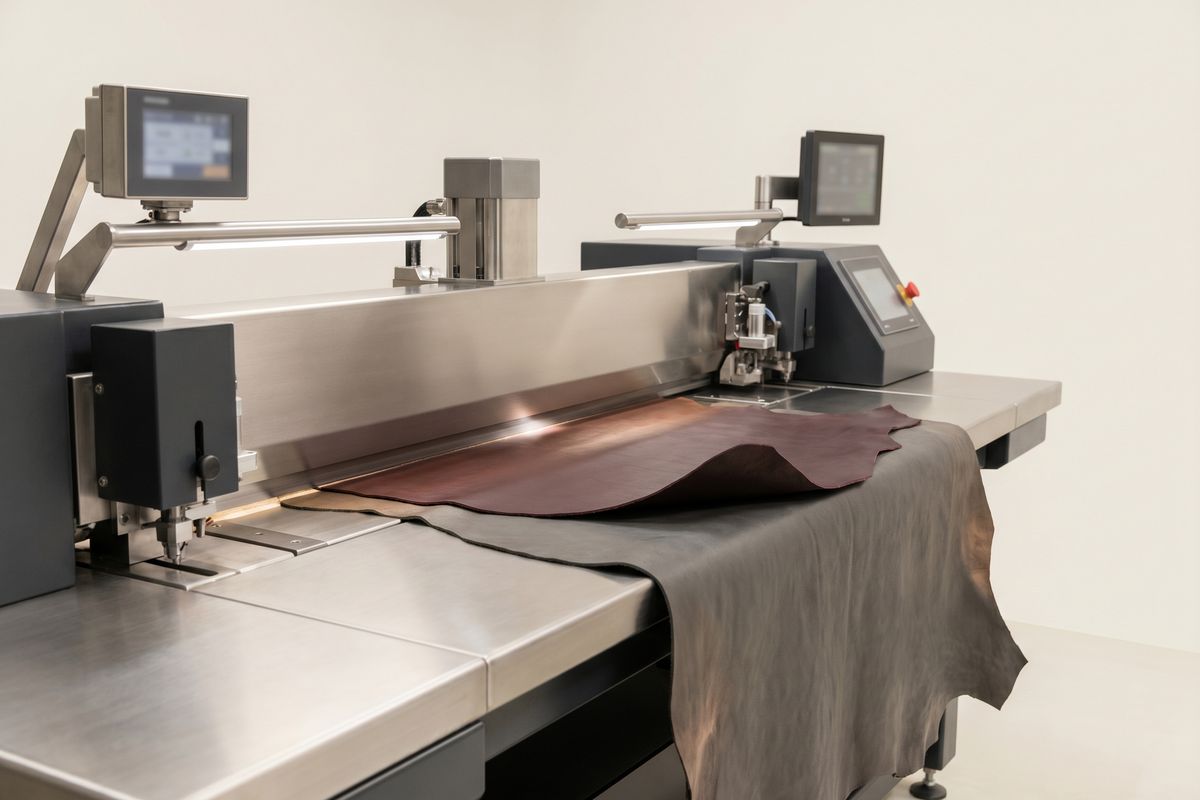
Because a hide is an irregular shape, leather is bought and sold by area — almost always in square feet (square decimetres in metric markets). Each hide is measured precisely — historically by a pin-wheel machine, now usually by an optical scanner — and stamped with its exact area. You order the square footage you need, allowing for the fact that real hides come in natural shapes and yield.

How thick the leather is — set at shaving, chosen for the job.
"Substance" is simply thickness, usually given in millimetres — and sometimes in older units: irons (one iron ≈ 1/48 inch) for soles, or ounces (one ounce ≈ 1/64 inch) in some markets. Thinner, suppler leather suits linings and garments; thicker, firmer leather gives structure. It's locked in at the shaving stage.
The words for the pieces a hide is cut into.
A hide is the whole skin of a large animal. Cut down the backbone, each half is a side — easier to handle, and the usual trading unit. Slice a hide through its thickness and you get layers: the grain (the prime top) and the split (the underside beneath it). Knowing which you're buying matters — a grain side and a split are very different materials at very different prices.
No terms match that search. Try a simpler word — or write to the library and we'll add it.
This glossary grows. If there's a term you've heard and can't pin down — or one we've missed — write to the library and we'll add it.
library@aeristo.com